Showing posts with label Wyoming Humanities Council. Show all posts

Monday, June 27, 2011

Voices of Freedom/Faces of Freedom features community portraits at July 4's Music in the Hole

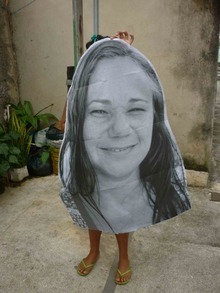
Roseneide G, Providencia, Brazil
Tedx Jackson Hole has joined the global art project initiated by TEDPrize winner, the French street artist and photographer JR, and you are invited to be part of the fun! In partnership with the Grand Teton Music Festival and the Wyoming Humanities Council we have launched Voices of Freedom/Faces of Freedom.
There are three elements:
1. During GTMF’s Music in the Hole Celebration on the Fourth of July, personal statements about the meaning of Freedom will be incorporated into one of the pieces of music
2. A large photo installation featuring poster-size portraits of the will be exhibited (location TBD) outside as a public art installation during July
3. Photos and personal statements will be uploaded as part of TED Prize-winner JR’s Global “Inside Out” art project. Check out www.insideoutproject.net to browse what has already been uploaded and see for yourself what we have in mind!
You can participate in any and all of this. We would like at least 100 and would welcome 1,000! Here is what you would need to do:
Answer the question “What does Freedom mean to you?” Define it any way you wish—it is a big notion—and send it to us. We will arrange to take your portrait and will take care of the rest. We will have a photo booth at Music in the Hole in partnership with the Wyoming Humanities Council’s “Rumination Wheel,” as well.
Please pass this on to anyone you think might be interested. If you are involved with a group or organization that would like to participate en masse, that is welcomed, too!

Wednesday, June 22, 2011

Buffalo Bill Boycott rides into Cheyenne July 10

Join us at the Historic Governor's Mansion on Sunday, July 10, 1:30-3:30 p.m. for a performance by Lander's Buffalo Bill Boycott, a Wyoming and western entertainer (and a member of the Wyoming Arts Council's artist roster). A free family event. Location: 300 E. 21st Street., Cheyenne. 307-777-7878. FMI: http://buffalobillboycott.com

Monday, June 20, 2011

Arts Council and Humanities Council team up at Wyoming Association of Municipalities conference

The Wyoming Arts Council's Mike Shay staffs the booth shared by WAC and the Wyoming Humanities Council at the Wyoming Association of Municipalities (WAM) conference in Sheridan on June 10. WCH staffers (not pictured) Jason Burge and Sheila Bricher-Wade stopped in Sheridan for their state tour promoting "Civility Matters." Photo by Jason Burge.

Friday, June 10, 2011

"Civility Matters!" grants available now

From our colleagues at the Wyoming Humanities Council: 
The Wyoming Humanities Council seeks public humanities projects with innovative approaches to the topic of civility, especially those focusing on creative formats, new or underserved audiences including youth, and community partnerships.
Maximum funding: $5000
Deadlines: Monthly, postmarked on or before the first of the month
Grant period: Starting February 1, 2011, and continuing until all funds are expended.  Projects must be completed by June 30, 2012.
Decision making: Grants Committee of the Wyoming Humanities Council

Thursday, December 2, 2010

Date change for "Civility Matters" in Cheyenne

From the Wyoming Humanities Council:

Join Us for "Civility Matters! The Decline of Legislative Civility — But Not in Wyoming."

Friday, December 10, 5:30-7 p.m.

Historic Plains Hotel, 1600 Central Avenue, Cheyenne.

Join us for refreshments and conversation about Wyoming’s place in the national debate over declining legislative civility.

Leading the dialogue at 6 p.m. will be Rutgers University legislative scholar Alan Rosenthal speaking on “The Decline of Legislative Civility — But Not in Wyoming.” Rosenthal, a professor of public policy at Rutgers University, researches and teaches about state legislatures and state politics.

The author of numerous books on state legislatures, he has worked with legislatures in most of the states and with the three national legislative organizations. His most recent book is Engines of Democracy: Politics and Policymaking in State Legislatures. In 2006 he was the recipient of an award for lifetime achievement from the National Conference of State Legislatures and the State Legislative Leaders Foundation. He is currently chairman of the New Jersey Legislature’s Joint Legislative Committee on Ethical Standards.

"Civility Matters!" is a multi-year initiative of the Wyoming Humanities Council which offers promotion and online and face-to-face programs on the topic of civility. Residents of the Cowboy State will have broad opportunities to consider the meaning of civility, both in the context of the nation’s democratic commitments to freedom of expression and in the context of an increasingly global world.

Funding is provided by the Wyoming State Legislature through the Wyoming Department of State Parks and Cultural Resources, the University of Wyoming Outreach School, and the National Endowment for the Humanities. "Civility Matters!" complements the National Endowment for the Humanities (NEH) 50-state American Civility Tour, conducted by NEH Chairman Jim Leach in 2010-2011.

The Wyoming Humanities Council is a nonprofit organization affiliated with NEH. For more information about the event or the Wyoming Humanities Council, call 307-721-9243 or visit www.uwyo.edu/humanities.

Civility Matters! The Decline of Legislative Civility -- But Not in Wyoming w/update

UPDATE: PLEASE NOTE THAT THE DATE HAS BEEN CHANGED TO FRIDAY, DEC. 10

Thursday, December 9
5:30-7 p.m.
Cheyenne Depot Museum

Join us for refreshments and conversation about Wyoming's place in the national debate over declining legislative civility. Leading the dialogue will be Rutgers University legislative scholar Alan Rosenthal speaking on "The Decline of Legislative Civility-But Not in Wyoming." Rosenthal, a professor of public policy at Rutgers University, researches and teaches about state legislatures and state politics. The author of numerous books on state legislatures, he has worked with legislatures in most of the states and with the three national legislative organizations. His most recent book is Engines of Democracy: Politics and Policymaking in State Legislatures. In 2006 he was the recipient of an award for lifetime achievement from the National Conference of State Legislatures and the State Legislative Leaders Foundation. He is currently chairman of the New Jersey Legislature's Joint Legislative Committee on Ethical Standards.


Civility Matters! is a multi-year initiative of the Wyoming Humanities Council which offers promotion and online and face-to-face programs on the topic of civility. Residents of the Cowboy State will have broad opportunities to consider the meaning of civility, both in the context of the nation's democratic commitments to freedom of expression and in the context of an increasingly global world. Funding is provided by the Wyoming State Legislature through the Wyoming Department of State Parks and Cultural Resources, the University of Wyoming Outreach School, and the National Endowment for the Humanities. Civility Matters! complements the National Endowment for the Humanities (NEH) 50-state American Civility Tour, conducted by NEH Chairman Jim Leach in 2010-2011. The Wyoming Humanities Council is a nonprofit organization affiliated with NEH. For more information about the event or the Wyoming Humanities Council, call 307-721-9243 or visit www.uwyo.edu/humanities;  http://www.uwyo.edu/humanities

Tuesday, October 26, 2010

Wyoming Humanities Council offers civility program as an antidote to these "uncivil" times

Milward Simpson, director of the Wyoming Department of State Parks and Cultural Resources, wrote a guest op-ed for the Oct. 24 Casper Star-Tribune. His essay focused on the new Wyoming Humanities Council program on a timely topic -- civility. This is a slightly longer version of the CST op-ed:

October is National Arts and Humanities Month. In honor of the occasion I’m writing to announce that the Wyoming Humanities Council (WHC) will be conducting a new series of programs and activities beginning in fall 2010 bringing Wyoming citizens together to focus on an important and timely topic: civility.

Much has been made of these “uncivil” times. As Americans, we are all familiar with the words and images that have characterized our political landscape in recent months and years: politicians resorting to ugly personal attacks and extreme public statements, the advent of the inchoate tea party movement and the inchoate, mocking response to it, all this amorphous anger, the mob chaos of political town meetings, entire TV “news” programs devoted to one-sided polemic, and here, closer to home, the uproar over Bill Ayers and extremists threatening to burn religious texts on the capitol steps. Even in Wyoming where we know that we daren’t offend our neighbor for risk of offending the entire community that sustains us, we are not immune.

The fuel we seem to keep pouring onto the fire is distilled from a variety of sources: the proliferation of electronic communication leading to an increasingly polarized media (what journalists Halperin and Harris refer to as “the freak show”), the increasing geopolitical phenomenon in which people choose to live where their political views will be reinforced (what author Bill Bishop refers to as “The Clustering of Like-Minded America;” and a frustrated electorate facing the seeming impossibility of getting anything done in the almost complete absence of compromise – we have all been burned by the volatility of these forces.

Of course, our democratic experiment has often been characterized by periods of national upheaval where incivility reigned. The publication “America’s Civil War” in its most recent issue stated “…if you think politics are polarizing now, try to imagine the angst in this country after Abraham Lincoln was elected president 150 years ago…” Cabinet members resigned, seven states voted to secede from the Union and Federal property in South Carolina was confiscated and/or destroyed leaving Ft. Sumter as the only federal property remaining. Yet, though far perhaps from the depth of the divisions which resulted in our great Civil War, the word “secession” has wormed its way back into the national dialogue. Our current cultural environment does call into question the cohesion of our nation and our collective ability to confront the enormous issues facing us - economic, environmental and social.

It is not that we should disagree less. Indeed, part of our American dynamism comes from the fact that we are born and bred to argue. Our democracy draws its strength from it. The esteemed journalist Howard Fineman in his book “The Thirteen American Arguments,” argues that, if anything, we don’t argue enough “…about the fundamentals. The … arguments bitterly divide us, but they also define, inspire, and ultimately unite us by bestowing legitimacy on hard fought deals…”

The difference today seems to be civility – what National Endowment for the Humanities Chairman Jim Leach refers to as the willingness and ability to “walk in another’s shoes.” I had the honor of meeting Mr. Leach during his visit to Wyoming last month as part of his 50-state “American Civility Tour.” Leach, a 30-year Iowa Congressman known for his effectiveness in working across the aisle, launched his tour to “call attention to the need for civility in public discourse.” I have seldom met a more erudite gentleman, yet, he puts this all very simply: “Civilization requires civility. Words matter. Polarizing attitudes can jeopardize social cohesion.”

While pondering this piece, I thought of civility in light of my own family’s history of public service. Many of us are known to be “scrappers” who don’t back down from a fight and are prone, for better or worse, to speak our minds. My grandfather Milward, during his term as Governor in the late 1950’s, once wrote a quite uncivil letter responding to a constituent who seems to have taken issue with his conduct in office. Granddad dashed off his vitriolic missive and told his Chief of Staff Bob McManus to “mail the thing to that #@$&% SOB.” Bob did as he was told. Later that day, Governor Simpson came to him and asked, “…you didn’t mail that letter, did you!?” Bob said that he had. Granddad exclaimed something like “Oh God, we’ve got to go get it!” and they walked (I’m sure with less than sure legal footing) to the postmaster who agreed to retrieve the letter before it left the post office. From then on, when granddad had occasion (as he apparently continued to do) to direct his Chief of Staff to “mail the thing to that dirty rotten…!” or something of the like, Bob would wisely pocket the letter so when he was asked the inevitable “you didn’t mail that thing did you!?,” he simply retrieved it from his vest pocket – a sort of “pocket veto” of an uncivil instinct, for which the family is eternally grateful.

How do we confront this issue here in our beloved, wonderful and still wild Wyoming? The Wyoming Humanities Council’s Civility Matters! initiative was inspired by Chairman Leach’s call to action. The WCH describes these statewide programs as being “…presented in a variety of formats and will explore historically contentious events, as well as contemporary state, national, and international issues. Wide-ranging topics may include "cyber-civility" and public discourse in the digital age; sports and civility; cyber and school bullying; academic freedom; generational differences; national topics, such as second amendment rights, labor relations, and energy and water issues; regional topics, such as the Rock Springs Massacre, the Johnson County Wars, and the World War II Heart Mountain Relocation Center; and international topics, such as Islamic contributions to world cultures and the Iraq/Afghanistan wars.” The variable format for these discussions is intended to encourage interaction and will include visiting scholar presentations, online film and book discussions, summer watermelon/ice cream socials, publications, and community potluck dialogues.

The Department of State Parks and Cultural Resources is proud to provide support for these programs and feels they will benefit Wyoming as we explore the issue as a state and rededicate ourselves to our proud “live and let live” credo, to arguing and disagreeing while retaining our civility and our mutual respect. Back to Fineman, our civil discourse, our arguments, “…produced a civil war, the still-smoldering embers of racial tribalism, and pitiless economic competition; but they also produce the freest of societies, an ongoing (if imperfect) accommodation between capital and community, and a Constitution that stands as a beacon to the world even if we sometimes honor it in the breach. Arguing keeps us moving fitfully forward – toward being worthy of the gifts God gave us.”

As we celebrate National Arts and Humanities Month, I invite you to participate in these activities and be a part of this important discourse. After all, it’s the American thing to do!

Tuesday, October 19, 2010

Join today's conversation with The President's Committee on the Arts and Humanities

Today's Tuesday Talk from the White House features The President’s Committee on the Arts and Humanities.

On the White House blog, Kori Schulman has the following info:

Join us for two talks on Tuesday, October 19:

•1:30 p.m. EDT: Talk with Austan Goolsbee, Chairman of the Council of Economic Advisers, on the economy.

•2:15 p.m. EDT: In celebration of National Arts and Humanities Month, talk about the arts and arts and humanities education with co-chairs and members of the President's Committee on the Arts and Humanities (PCAH), including:

Chuck Close, Member and visual artist
Margo Lion, Co-Chair
George Stevens, Jr., Co-Chair
Damian Woetzel, Member and ballet dancer

Here's how you can participate:

•Ask your questions in advance on Facebook
•Watch the chat through www.WhiteHouse.gov/live
•Join the discussion live through the White House Facebook application
Link up by going to http://www.whitehouse.gov/blog/2010/10/15/two-tuesday-talks-austan-goolsbee-economy-president-s-committee-arts-and-humanities

Wednesday, September 29, 2010

What are your plans for National Arts & Humanities Month?

Each October, Americans for the Arts in Washington, D.C., asks arts communities nationwide to host arts events and make them part of National Arts and Humanities Month (NAHM) by posting events on its web site and sharing pictures and stories with peers nationwide. Add your event to the NAHM Calendar. Find out what arts groups and their partners are doing to celebrate and use other available NAHM tools to promote your events and to advocate for the arts at www.AmericansForTheArts.org/NAHM.

Monday, September 27, 2010

Mammoth good time had by all at book festival


Saturday began with Australian Aboriginal creation stories, and then moved to Hawaiian shark mythology. In the afternoon, Wyoming's 11,000-year-old mammoth was stomping through the Tate Geological Museum and prehistoric armored Hell Pigs were hot on my imaginary trail.

Wish all Saturdays could be as exciting.

But that was bookfest Saturday in Casper. The Casper College/ARTCORE Equality State Book Festival is an extravaganza of books and writers and myths and legends and poetry and fun.

In the interest of full disclosure, I must admit that I've been on the bookfest planning committee since its inception six years ago. This makes me slightly biased, yet still wildly enthusiastic.

More than 20 writers in two days. You can find a full list at the bookfest web site. You may recognize names of the Wyoming writers: Poet Laureate and musician David Romtvedt, writer and "grasshopper guy" Jeff Lockwood, Gene "The Teacher Who Dances on Desks" Gagliano, the didjeridoo-playing storyteller Paul Taylor, Nina Swamidoss "Cowboys and East Asians" McConigley, children's author and illustrator Zak Pullen, and Tom "Mr. Carnegie's Dinosaur" Rea.

Other presenters included authors, poets and book illustrators from Idaho, New York, Alaska, Belgium, Massachusetts, Pennsylvania and other exotic places.

John Vernon is an historical novelist from New York who justy spent years exploring a topic that's maybe even more mythic than dinosaurs -- Billy the Kid. Vernon's latest is "Lucky Billy." He read some passages Friday evening and then talked about research on Saturday.

While he agrees with the old saw "write what you know," Vernon likes to add this: "know more." That's where research comes in. He usually starts each book with a trip to the setting. In "The Last Canyon," that was the Green River in Wyoming. For "Lucky Billy," he traveled to Lincoln, N.M., which hasn't changed much in the past 120 years. He then explores the "material culture" of the period. He had to learn volumes about firearms of the 1880s. He read a two-page section heavy with gun lore. He had to be careful not to be a "show off" with all this newfound knowledge.

"You should be subtle with your research," he said. "It should be delivered in passing."

Because his books are heavy on dialogue, Vernon researches slang of the era. Old newspapers, letters and diaries and books are great for this.

"You're building a scaffolding of facts," he said. "But in the end, nothing is possible in a novel without imagination."

And no book festival is possible without imagination. Scaffolding, too.

--Michael Shay

Monday, September 20, 2010

Tonight at Casper College: "Happily Ever-Aftering on a 1920s Cattle Ranch"

The Equality State Book Festival is holding a "pre-fest" event tonight (Monday), Sept. 20, 7-9 p.m., with a presentation by Montana author John Clayton. He will speak about "Happily Ever-Aftering on a 1920s Cattle Ranch" in the Goodstein Foundation Library Lobby at Casper College.

John’s reading is brought to you by the Casper College Gender Studies program and a Wyoming Humanities Council grant. In his presentation, "Happily Ever-Aftering on a 1920s Cattle Ranch", John will discuss the story of Caroline Lockhart. A best-selling Wyoming novelist of the times, Carolyn decided to retire to her very own homestead, setting in motion a conflict: The happy endings of her romantic fictions and the realities of a single woman running a drought-ridden ranch.

The event is free and open to the public.

The book festival kicks off in earnest on Friday, Sept. 24, 8 a.m. See the web site for more info

Author Marcia Hensley and musician Miss V enliven Wyoming Women's Foundation celebration on Oct. 9

The Wyoming Women's Foundation is celebrating its 10th anniversary with a luncheon on Saturday, Oct. 9, 11 a.m.-2 p.m., at the CFD Old West Museum in Cheyenne. Keynote speaker will be Wyoming historian and author Marcia Meredith Hensley with a performance by Wyoming Arts Council roster artist Miss V (shown in photo) from Cora, Wyo.

Tickets are $25/person.

To make a reservation offline or if you have any questions, please email Richelle Keinath or call (307) 721-8300.

Thursday, September 16, 2010

As a landmark is destroyed, we remember the short but lively history of book festivals in Wyoming

Smoke is in the morning air. Residue from the fire that destroyed the Hitching Post Inn, a Cheyenne landmark.

The Hitch was the site for the first Wyoming Bookfest on Oct. 26-27, 2001. We remember that fall for the 9/11 attacks on the Twin Towers and the anthrax attacks on Congress. Then came the invasion of Afghanistan by U.S. forces. Smoke was in the air everywhere that year.

Meanwhile, in Cheyenne, a handful of writers and booklovers were organizing what we hoped would become an annual tradition.

If I remember correctly (and I don’t always) the idea started with a meeting of local writers Chip Carlson and Larry Brown with Gene Bryan, who then was in charge of events at the Best Western Hitching Post Inn Resort and Conference Center, a.k.a. “The Hitch.” That’s pretty much what everyone called it, then and now.

The three co-conspirators thought a bookfest was just the thing for Cheyenne. Unlike its surrounding states, Wyoming had yet to have a statewide book festival. It would benefit writers, booksellers and The Hitch.

Linn Rounds, then head of the Wyoming Center for the Book, was pulled into the committee. So was I from the Wyoming Arts Council. Kathy Murphy, secretary to Wyoming Department of State Parks and Cultural Resources Director John Keck, volunteered to keep track of all the proceedings. She did a great job, Kathy, alas, died a few years later. In the end, we had a great collection of people, including Kathleen Gillgannon of the YMCA Writer’s Voice, and reps from the Laramie County Public Library and the Wyoming Humanities Council.

Warning for anyone planning a book festival – it’s a lot of work. Forty-two poets, writers, editors, storytellers, musicians and at least one wood sculptor participated in the Oct. 26-27 event. That doesn’t include booksellers and presses featured at the book fair. Committee members were running around like crazy people, getting people to the correct rooms and finding more chairs when needed.

It got off to a heady start with a Friday evening reading by four poets laureate: Robert Roripaugh of Wyoming, Mary Crow of Colorado, David Lee from Utah and Bill Kloefkorn of Nebraska. The crowd was SRO, and it was a real thrill to have four great poets reading their work at one event. Just think of how many square miles are represented by these people from four big almost-square states (Nebraska's more of a weird rectangle).

David Lee was fresh from his appearance at the first National Book Festival on the National Mall in D.C. That event was organized by the Library of Congress and First Lady Laura Bush.

We also had a guest speaker that evening in U.S. Sen. Mike Enzi. Sen. Enzi and his staff no longer had access to their offices in D.C. due to the anthrax attacks. So he brought a batch of staffers with him to Cheyenne. He spoke about the recent happenings in the capital, but then launched into one of his favorite subjects – books. He’s a big reader – I’ve watched him buy bags full of books from appreciative Wyoming writers.

Sen. Enzi also was in town for a very somber event. This was the funeral of one of the first American soldiers killed in Afghanistan. U.S. Army Spec. Jonn Edmunds of Cheyenne was on a helicopter ferrying troops to the war zone when it crashed Oct. 19 in Pakistan. All aboard were killed.

Thousands attended the Saturday funeral. We had hoped for thousands that day at the bookfest, but fell a bit short. It wasn’t for lack of trying. We had fantastic sessions on writing cookbooks, westerns, mysteries and poetry in rooms scattered throughout The Hitch. We had some of the best anthology editors in Wyoming – Nancy Curtis, Candy Moulton and Bill Hoagland -- talking about “Editing Western Anthologies.” Local writer C.J. Box, who’s now published more than a dozen mysteries and won the prestigious Edgar Award, talked about “Whodunits on the High Plains.” I was on a panel with writers Teresa Funke and Jeffe Kennedy talking about “Starting (and Maintaining) Your Writing Critique Group.” My group is still intact, as is Teresa’s. Jeffe’s group in Laramie is defunct – and she now lives in Santa Fe.

On the Children’s Stage in the now-destroyed Saddleback Lounge, my son and his pals at East High staged an open mike. It also saw performances by Aussie storyteller Paul Taylor and the Cheyenne Youth Symphony.

We were exhausted by the end of the day. In the ensuing weeks, we went over all the evaluations. Most negative comments were about lack of attendance and lack of book sales. Lots of people had lots of ideas about how to make it better. More publicity. More big-name authors. Bigger book fair. Get more people to do the work. Involve more local organizations and business.

Here’s one comment I liked: “A number of authors travel a great distance to attend — at last give them a sandwich for lunch.”

You want mayo or mustard with that?

Here’s a great comment from C.J. Box: “The bookfest shouldn’t be all things to all people… While musical performances and wood art may bring in some folks, the bookfest should be about books and authors.”

A few months after the bookfest, the committee met for a brainstorming session. We stormed our brains out. We all wanted to have another bookfest, but there wasn’t enough interest to form a solid committee to write grants, enlist sponsors and plan the myriad bookfest details. Not right away, anyway.

It was five years before there was another book festival. This one was a true statewide book event, the Equality State Book Festival in Casper. It was six years before there was another bookfest in Cheyenne, and that was the Wyoming Book Festival in locales throughout downtown Cheyenne. It continues to be a project of the Wyoming Center for the Book at the Wyoming State Library.

Planning for the first ESBF began in late 2004. It involved a very motivated and dependable planning committee. A big budget too – more than $100,000. Lots of sponsoring organizations in Casper and throughout Wyoming.

The third ESBF will be held Sept. 24-25 at Casper College and environs. I’m on the committee but the real work is done by the Casper organizers, notably co-chairs Laurie Lye and Holly Wendt of Casper College.

Here’s to you, bookfest organizers. Lots of work and little glory. But people come out to see their favorite authors and buy books. Every year, bookfest authors go to local schools to get kids excited about reading. Bookstores sell books. Authors read from their books. There’s a late-night slam for poets. Workshops for striving writers and poets.

We’ve all learned some lessons since that first bookfest when the smoke and ashes from 9/11 were still in the air.

The Hitch was not officially an historic site, just the place of many memories for many people. Nine years ago it was the place where we constructed the foundation for bookfests to come. Now it’s smoke and ruins.

See you in Casper Sept. 24-25 as we keep building bookfest traditions in Wyoming.

--Michael Shay

This story was cross-posted (in a slightly different form) from the hummingbirdminds blog
Tuesday, September 14, 2010

Wyoming Humanities Council launches "Civility Matters" initiative at Heart Mountain site

From a SPCR press release:

A year-long initiative, sponsored by the Wyoming Humanities Council, titled “Civility Matters,” kicks off at the Heart Mountain Relocation Center near Powell Saturday, September 18 at 11:15 a.m.


Featured at the event is National Endowment for the Arts Chairman Jim Leach and Former U.S. Senator Alan Simpson, a board member of the Heart Mountain, Wyoming Foundation.

Following the kick-off of “Civility Matters,” Leach and Simpson will also participate in “A Conversation on Civility with NEH Chairman Leach and Senator Alan Simpson” at Northwest College in Powell at 1 p.m.

Two journalism and political science students will interview Leach and Simpson with the session introduced by Northwest College President Paul Prestwich and moderated by faculty member Lou McPhail. The public is welcome.

Leach, a long-time Republican Congressman from Iowa, who became head of the NEH in August 2009, will provide a major address, “Civility in a Fractured Society,” at 7:30 p.m., that evening at the Buffalo Bill Historical Center in Cody. Both events are free and open to the public.

The events coincide with Leach’s 50-state “American Civility Tour.” Additionally, the Wyoming Humanities Council announces 12 months of promotion and online and face-to-face programs on the topic of civility, offering residents of the Cowboy State broad opportunities to consider the meaning of civility, both in the context of the nation’s democratic commitments to freedom of expression and in the context of an increasingly global world.

With funding provided by the Wyoming State Legislature through the Wyoming Department of State Parks and Cultural Resources, and the National Endowment for the Humanities, programs include a partnership with the Casper Star-Tribune, featuring opinion editorials by humanities scholars and professionals, state leaders and Wyoming citizens; statewide book and film discussions; a publication with selected readings; an innovative summer public discussion series in Wyoming’s community and state parks; a community grant initiative; and a statewide tour by a national humanities scholar, who will culminate the year with presentations at Wyoming potlucks and schools.

The Wyoming Humanities Council is a nonprofit organization that is an affiliate of the University of Wyoming and the National Endowment for the Humanities. It provides community programs and funds community grants across Wyoming. The Wyoming Humanities Council, the Heart Mountain, Wyoming Foundation, and the Buffalo Bill Historical Center are sponsors of Leach’s Wyoming visit. For more information about the Wyoming Humanities Council, call 307-721-9243 or visit www.uwyo.edu/humanities.

Wednesday, September 1, 2010

University of Wyoming receives "largest estate gift in its history" from artist and arts patron Neltje

This just in from the University of Wyoming PR office:

University of Wyoming officials said today (Wednesday) the university has received the largest estate gift in its history, a bequest that will transform the university's role in the arts in Wyoming and across the United States.
The estate gift is from Wyoming artist, Neltje (shown in photo), a prolific abstract expressionist whose works have been described as an "exploration of making the sensed visible."
The gift includes all financial and land holdings save for those going to her children and a select few personal donations. Additionally, the gift includes a world-class collection of contemporary, tribal and ethnic arts collected by Neltje over a lifetime of travel across the globe.

"If ever there was tangible evidence of the power of philanthropy, this is it," UW President Tom Buchanan says. "We can't thank Neltje enough for her vision and her commitment to the university and to the arts in Wyoming. It is simply remarkable."

The gift will enhance the UW Art Museum and the university's visual and literary arts programs, and it will enable UW to provide talented students with once-in-a-lifetime arts education opportunities unmatched in the United States.

The gift was announced just as the university is breaking ground for its new $33 million Visual Arts Center  see previous wyomingarts post) next to the UW Centennial Complex on the Laramie campus, which is home to the Art Museum and the American Heritage Center. Neltje's gift, combined with the significant investment in the new Visual Arts Center, promises to forever change the landscape for the fine arts at UW.

When this gift is realized, her home will become the heart of the UW Neltje Center for the Visual and Literary Arts, a place to honor and showcase the contemporary visual and literary arts and an educational facility for residencies, workshops, symposia, conferences, art exhibitions and literary readings.

"My heart belongs to Wyoming," says Neltje. "The incredible and vast landscape and the independent people have given me the inspiration to become who I am. My gift to the University of Wyoming is a gesture of my caring for future generations."

The Neltje Center will be open for UW activities related to the arts and also to the public for special events, conferences and celebrations. It will celebrate an expansive, sophisticated awareness of the arts and includes both the literary arts as well as contemporary art.

The gift includes a partnership with Jentel, a private foundation established by Neltje in 2000 that is located adjacent to her home. Jentel provides on a working ranch a residency program for visual artists and writers from across the country. The foundation strives to protect the pristine natural environment of the Piney Creek Valley.

"Neltje's extraordinary gift will transform the arts at the University of Wyoming, creating research and educational opportunities at the future Neltje Center and supporting the creative work of artists internationally through the artist residency program at Jentel," Susan Moldenhauer, director and chief curator at the UW Art Museum, says. "It will advance the Art Museum's mission through new collections, exhibition opportunities and museum-based research and education initiatives."

"Jentel will create a synergy of purpose with the Neltje Center, and the university," adds President Buchanan. "It will cultivate creativity and collaboration among artists in the residency program, students and artists from the university, and the public drawn to the Big Horns and this special place."

Neltje was born in New York City and raised in Oyster Bay, Long Island. In 1980 she took a few classes at the New York Studio School of Drawing and from 1979-80 she took a few classes at the Art Students League in New York, N.Y. She is essentially self-taught.

In 2005, she was recognized as one of Wyoming's preeminent artists with the Governor's Arts Awards. She received an honorary degree from Rocky Mountain College in Billings, Mont., and is the founder and benefactor of the Neltje Blanchan Literary Award in memory of her grandmother [and Frank Nelson Doubleday writing award in memory of her grandfather]. She served on the Board of the Wyoming Arts Council from 1985 to 1988.

Neltje's work has been featured in collections at the Smithsonian, the Yellowstone Art Museum in Billings, Mont., the IBM Corporation in Denver and the Wyoming State Museum in Cheyenne, among others. In addition, her work is in private collections in California, Colorado, Montana, New Mexico, New York, Pennsylvania and Wyoming.

Friday, August 20, 2010

NEH Chairman Jim Leach speaks about "Civility in a Fractured Society" at BBHC on Sept. 18

Press release from the Wyoming Humanities Council:

On September 18, the public is invited to participate in events honoring Jim Leach, chairman of the National Endowment for the Humanities, who will visit Wyoming as part of his fifty-state civility tour. Wyoming welcomes Leach to Heart Mountain Relocation Center at 10:30 a.m. for a public ceremony and tour, followed by a 1:00 p.m. conversation with students and faculty at Northwest College, Powell. Culminating the visit will be a 7:30 p.m. public address by Leach on "Civility in a Fractured Society" at the Buffalo Bill Historical Center, Cody.

Leach introduced his fifty-state tour in November 2009 to call attention to the need for civility in public discourse. "Civilization requires civility," says Leach. "Words matter. Polarizing attitudes can jeopardize social cohesion."

Leach began his four-year term as NEH chairman in August 2009 after serving 30 years in the U.S. House of Representatives. As a congressman representing southeastern Iowa, he chaired the Banking and Financial Services Committee, the Subcommittee on Asian and Pacific Affairs and the Congressional-Executive Commission on China. He founded and co-chaired the Congressional Humanities Caucus. Cosponsors for the events are the Buffalo Bill Historical Center; the Heart Mountain, Wyoming Foundation; and the Wyoming Humanities Council.

Leach's visit will also launch the Wyoming Humanities Council's year-long civility initiative, which will include an innovative lecture and discussion series, a visiting scholar, and grants for civility-themed projects.

Thursday, July 29, 2010

Organize una Discusion de Libros en Espanol Gratis

El programa de "Reading Wyoming", ofrece siete libros en espanol muy interesantes. El primero es "Bendceme Ultima" escrito por Rodolfo Anaya, es una historia llena de sueos sensuales, supersticiones, fenmenos inexplicados y la oscura fuerza de la teologa Latinoamericana. El segundo libro es "Lluvia de Oro" por Victor Villaseor, un narrativo sobre la riqueza cultural de Mxico, de una familia que sus tragedias son soportadas por el poder mstico y el amor incondicional, y todos los emigrantes: personas valientes que viven la vida con un espritu constante. El tercero es "Balun Canan" por Rosario Castellanos, es una novela que relata una serie de sucesos cotidianos que tienen lugar en un poblado chiapaneco cercano a Guatamela, Balan-Canan. En medio de la tensin en que coexisten dos mundos opuestos -el del hombre blanco y del indio chontal- se mueven diversos personajes en cuya vida se refleja una lucha dramtica y ancestral entre dos razas. El cuarto libro es "Como Agua Para Chocolate" por Laura Esquivel, es una historia que habla sobre el amor prohibido de una mujer Tita y su familia, y la manera como Tita expresa su vida por su cocina, empleja un realismo mgico para combinar lo sobrenatural con lo mundano. El quinto libro "Estacin Tula" por David Toscana, es una narracin que nos deja ver el conflicto entre la identidad del centro y la manera de vida en el norte de Mxico, nos enfrenta a la definicin de novela y a sus lmites de creacin e interpretacin y tambin ofrece al lector una serie de narrativas entrelazadas donde se confunden autor y personajes, ficcin y realidad. El sexto libro "Los de Abajo" por Mariano Azuela, es una historia que revela el drama de los hombres que no saben por qu luchan y tampoco saben cmo dejar de luchar, la novela tambin narra la vida de Demetrio Macas, campesino rebelde que se une a la lucha tras sufrir su familia vejaciones por parte de los soldados. El último libro "Mal de Amores" por Ángeles Mastretta es una narracin de una pasin entrejida entre la historia de un pas, de una guerra, de una familia y de varias vocaciones desmesuradas.

El Consejo de Humanidades de Wyoming, ofrece un programa de discusin de libros gratis para comunidades con patrocinio local de organizaciones sin nimo de lucro, o tambin agencias de gobierno como bibliotecas, museos, iglesias, o centro para la tercera edad. "Reading Wyoming" une los miembros de comunidades, y un lder de temas de humanidades habla sobre siete libros. Las organizaciones de patrocinio escogen las series de libros y reclutan los participantes.

El Consejo de Humanidades de Wyoming provee programas de humanidades públicos en compaa con organizaciones locales, y es patrocinado por La Deuda Nacional para humanidades (Nacional Endowment). Para mas informacin sobre el consejo de humanidades, visite: www.uwyo.edu/humanities o llamar (307) 721-9243

Humanities Al Fresco! at Yellowstone Sept. 18-19

From the Wyoming Humanities Council:

Retired National Park Service Historic Architect Rodd Wheaton will lead a Sept. 18-19 tour focused on the history and preservation of important structures and buildings in Yellowstone National Park. During the two-day bus tour, participants will learn about the park's earliest period as an army fort and the influence of rustic vernacular architectural styles on the impressive design of late 19th and early 20th century "parkitecture." Wheaton has authored dozens of National Historic Landmark and National Register nominations, including many in Yellowstone. He also played a leading role in rehabilitation efforts at Lake Hotel, Mammoth Hotel and Old Faithful Inn and many other Yellowstone resources. Participants will leave Cody in the morning of the first day, spend one night in the original portion of the Old Faithful Inn, and return to Cody late in the afternoon the following day. Keep an eye on this page, the council's facebook page, and the Wyoming Humanities Network blog for further details as they are available.


ADVANCE REGISTRATION and HOTEL RESERVATION REQUIRED

TOUR COSTS

A registration fee of $15 per person includes the bus ride, snacks and water on the bus and park entrance fees. The registration fee is payable by credit card or check.

Cancellations after August 17, 2010 will not be refunded.

Participants will be asked to sign a waiver and provide emergency contact information before boarding the bus.

TRANSPORTATION

The Wyoming Humanities Council will provide transportation for the September 18 and 19 Yellowstone National Park tour by Americoach of Cheyenne. The tour will be conducted on a 56-passenger Americoach bus. You may see a photograph of the bus at their web site.

The Wyoming Humanities Council will not provide transportation to or from Cody, prior to or following the tour. For an additional, separate cost, Americoach of Cheyenne may be available for pre- and post-transportation, to and from Cody. Interested tour participants may contact Judy Jaterka at Americoach: 1-307-635-6990, 1-866-635-6990 or wjjaterka@aim.com.

MEALS

Participants are responsible for paying for their own meals. A variety of price options will be available at each stop.

HOUSING

Participants in the Wyoming Humanities Council Yellowstone Tour must make their own hotel reservation by June 20, 2010.

To reserve one of the group rooms (shared bathrooms in the hall) in the Old Faithful Inn for the rate of $108.04 for 1 or 2 beds for 1 or 2 people, please call 307.344.5437 before June 20, 2010 and give the following code: GPWYHUM. The deposit for the room is the full overnight room rate of $108.04. There is an additional charge of $12 per person for each additional person (more than 2) who are 12 or older and are staying in the room. Children under 12 are free.

The deposit must be received at the time of booking the reservation and is payable by credit card.

Rooms reserved for the WHC Yellowstone Tour are "N" rooms (room without bath) in the "Old House" at Old Faithful Inn.

FMI: http://uwyo.edu/humanities